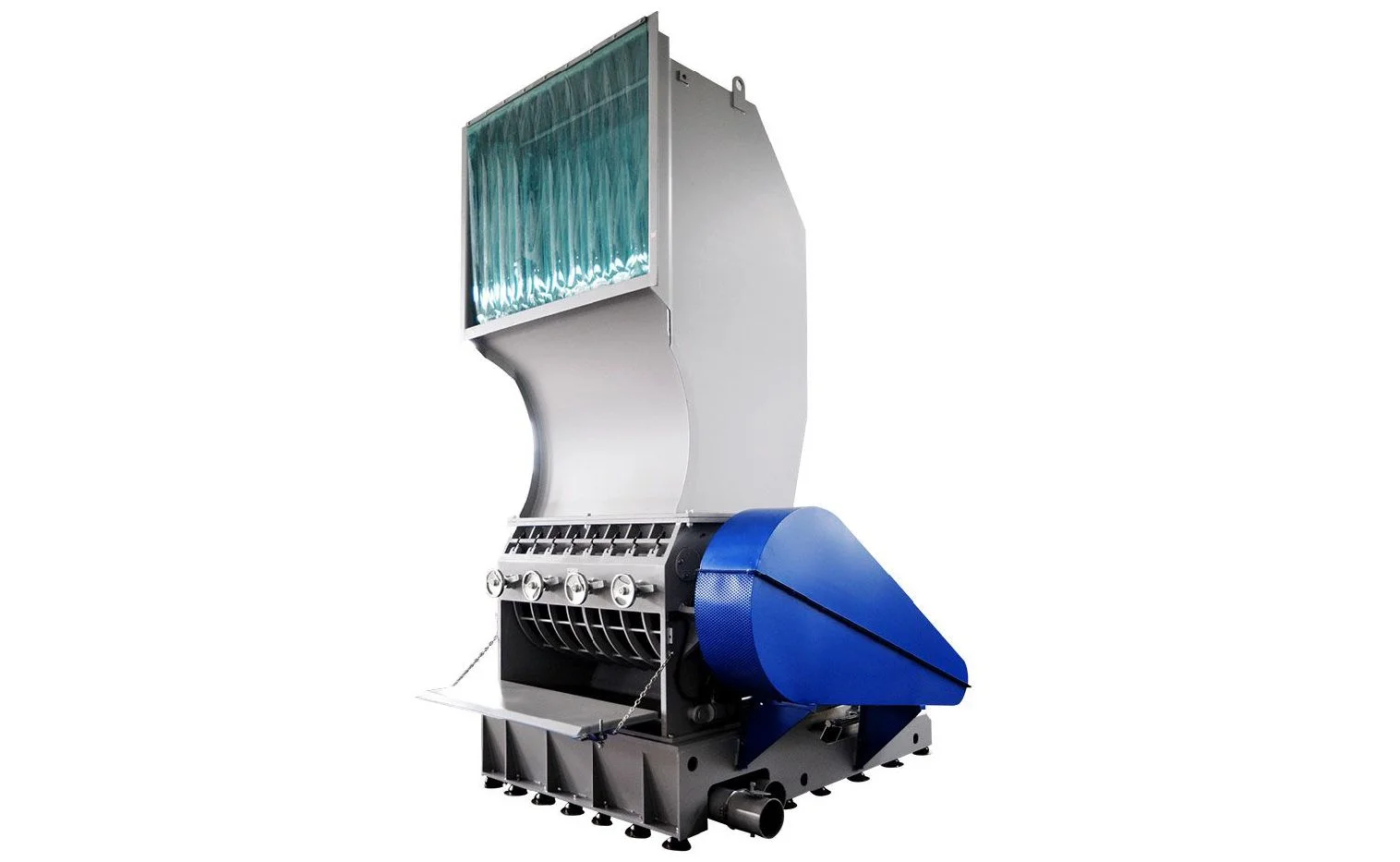
A heavy-duty granulator is an industrial machine designed to reduce plastic waste, production scrap, purgings, and regrind into consistent particle sizes suitable for reuse. Unlike shredders, which rely on slow-speed, high-torque shearing to break down bulk material, granulators operates at higher speeds with precision cutting to achieve a fine and controlled output.
Importance in Recycling and Manufacturing:
- Supports closed-loop material usage
- Reduces raw material purchasing cost
- Helps meet sustainability and waste reduction mandates
- Produces consistent granules for high-quality reprocessing
Working Principle of a Heavy-Duty Granulator
Heavy-duty granulators follow a defined cutting and screening process engineered for efficiency, accuracy, and throughput.
High-Speed, Low-Torque Operation:
Unlike shredders, granulators rely on high RPM cutting rotors to slice materials instead of ripping or tearing.
Precision Shearing Action:
Materials are cut between moving rotor knives and fixed stationary knives, ensuring uniform size reduction without degrading polymer quality.
Material Flow Path:
- Material enters feed hopper
- Moves into cutting chamber
- Cut to smaller pieces by rotor/stator knives
- Granules pass through sizing screen
- Final output conveyed or collected
Rotor Design: The Cutting Edge of Performance
The rotor serves as the central cutting component of a heavy-duty granulator and plays a critical role in determining cutting precision, material throughput, and overall energy efficiency.
Types of Rotors:
- Open Rotors – Ideal for film, fiber, and lighter materials; reduces heat buildup.
- Closed Rotors – Best for rigid parts and thick-wall components; provides stronger cutting force.
- Staggered Rotors – Ensures smooth, consistent cutting and reduces load spikes.
Role of Rotor Knives:
Rotor knives work with fixed knives to deliver precise cutting, minimizing heat, dust, and fines. High-quality knives also support longer lifespan and consistent particle geometry.
Impact on Output & Throughput:
Rotor shape and knife arrangement affect:
- Cutting efficiency
- Energy consumption
- Final granule size
- Noise & vibration levels
Cutting Chamber: The Core of the Granulation Process
The cutting chamber encloses the rotor and knife assembly, providing controlled material movement, optimal cutting efficiency, enhanced safety, and long-lasting structural strength for continuous industrial use.
Construction & Material Flow:
Heavy-duty cutting chambers are built with reinforced, abrasion-resistant steel to withstand continuous impact and high-wear environments. The internal design promotes smooth material flow, helping prevent blockages, overheating, or repeated cycling of material.
Stationary vs. Rotor Knives:
- Rotor knives rotate at high speed to cut material
- Stationary (stator) knives remain fixed and aligned Together, they form the shearing interface responsible for clean cutting.
Performance & Safety Factors:
- Clearance between knives
- Cutting angle geometry
- Chamber cooling & ventilation
- Noise & dust control
- Overload protection
Screening System Explained:
The screening system controls the final particle size of the processed material, ensuring a consistent and uniform granulate suitable for reuse or downstream processing operations.
Purpose of the Screen:
The screen functions as a precision sizing filter, allowing only correctly sized granules to pass through while oversized pieces remain in the cutting chamber for further reduction.
Structure & Specifications:
- Constructed from a durable, perforated steel plate located directly beneath the rotor
- Available in multiple hole diameters ranging typically from 3mm to 18mm, depending on material type and required output size
Adjusting for Material & Output:
- Larger screen openings provide higher throughput and coarser output particles
- Smaller screen openings deliver finer, more consistent granulate, suitable for reprocessing applications requiring uniformity
Key Applications & Industry Use
Heavy-duty granulators serve multiple end-use sectors and material streams:
| Industry | Examples of Use |
| Plastics | Injection scrap, blow-mold waste, purgings, films, profiles |
| Automotive | Bumpers, tanks, ABS parts, dashboards |
| Packaging | Bottle waste, rigid containers, thermoformed sheets |
| E-Waste | Casings, connectors, insulation plastics |
| Rubber | Soles, gaskets, seals, tire fragments |
| Manufacturing | Trimming waste & off-cuts for reuse |
Maintenance & Safety Considerations
Safety Features:
- Electrical interlocks
- Overload sensors
- Emergency stop systems
- Enclosed cutting chamber
Maintenance Best Practices:
- Inspect and sharpen knives regularly
- Monitor screen wear and replace as needed
- Check bearing alignment & lubrication
- Remove metal contaminants with magnets/detectors
Proactive maintenance extends machine life and ensures consistent regrind quality.
Conclusion:
At Virtus Equipment, we engineer our heavy-duty granulation systems with optimized rotor design, reinforced cutting chambers, and precisely matched screening solutions to ensure maximum productivity, consistent granule quality, long service life, and superior material recovery performance.
If you’re looking for industrial-grade Granulators for Plastics Recycling, we are ready to help you select the best machine for your material type, throughput requirements, and long-term operating efficiency.
Frequently Asked Questions:
How is a heavy-duty granulator different from a shredder?
A heavy-duty granulator uses high-speed cutting to produce uniform, fine granules suitable for reprocessing, while a shredder operates at low speed and high torque to break down bulky materials into coarse, irregular pieces for primary size reduction.
What materials can heavy-duty granulators process?
Heavy-duty granulators can process a wide range of materials including rigid plastics, purgings, film, fibers, thermoformed sheets, automotive plastic parts, rubber scraps, e-waste housings, cable insulation, composite materials, and certain wood-plastic products.
Can heavy-duty granulators run continuously?
Yes, heavy-duty granulators can operate continuously in high-volume recycling and production environments, provided they are correctly maintained. Routine knife sharpening, screen inspection, bearing lubrication, and cooling control are essential to maintain consistent output and prevent downtime.
What are common rotor maintenance tasks?
Common rotor maintenance tasks include regularly inspecting and sharpening knives, checking and adjusting blade gaps, tightening mounting hardware, inspecting bearings, lubricating moving components, and monitoring vibration or unusual noise that may indicate wear.
Does Virtus Equipment offer custom configurations?
Yes. We provide custom-engineered granulator and recycling system configurations, including specialized hopper designs, rotor styles, screen sizes, infeed systems, discharge options, sound enclosures, and full line integrations with shredders, conveyors, wash systems, and air-handling units.