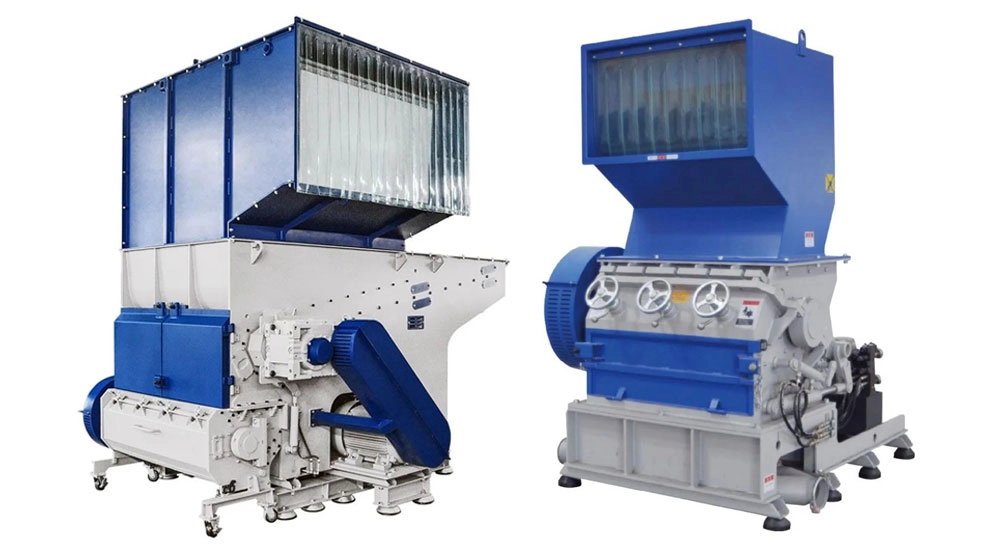
Recycling and size-reduction equipment play a crucial role in modern waste and material recovery industries. While shredders and granulators are often discussed together — and sometimes even used in the same processing line — they serve different operational purposes, deliver different output sizes, and are ideal for different material conditions.
Understanding their differences helps determine which machine to use, when, and in what sequence, allowing businesses to maximize efficiency, output quality, and return on investment.
What Is a Granulator?
A granulator is a high-speed cutting machine designed to reduce plastics and other materials into fine, uniform granules suitable for reprocessing or re-feeding into manufacturing equipment.
Functionality of a Granulator
- Operates using high-speed rotating knives and screens
- Produces consistent, fine particle size or flakes
- Ideal as a secondary size-reduction machine after shredding
Types of Granulators
- Heavy-duty industrial granulators
- Beside-the-press granulators
- Central granulation systems
- Pipe and profile granulators
- Low-speed granulators
- Thermoforming & film granulators
Common Applications of Granulators
PET, PP, HDPE, LDPE, ABS, PC, PVC & mixed scrap Resulting granules can be used again in injection molding, extrusion & compounding.
Reduces rubber parts, runners, sprues & tire components into reusable fine output.
- Wood & Paper Reduction:
Used for biomass fuel, pellet production & recycled pulp applications.
- Electronics Recycling:
Used after shredding to process housings, insulation, connectors & e-waste plastics.
What Is a Shredder?
A shredder is a low-speed, high-torque reduction machine that breaks down large, bulky, contaminated, or mixed materials for easier handling, sorting, or downstream processing.
Functionality of a Shredder
- Uses sharp hooks, shafts, or blades to tear & shear materials
- Produces larger particle sizes than granulators
- Handles voluminous, thick, irregular, and contaminated material
Types of Shredders
- Single-shaft shredders
- Dual-shaft shredders
- Quad-shaft shredders
- Heavy-duty primary shredders
Common Applications of Shredders
- Metal Recycling:
Aluminum, steel, copper, cables, and light scrap preparation
- Waste Management:
Municipal solid waste (MSW), RDF, bulky waste & landfill reduction
- Document & Data Destruction:
Confidential paper, textile labels, packaging labels, media devices
Pallets, lumber, bark, branches & biomass fuel production
Key Differences between Granulators and Shredders:
| Criteria | Shredders | Granulators |
| Primary Use | Bulk reduction | Fine size reduction |
| Cutting Mechanism | Shearing & tearing | High-speed cutting |
| Output Size | Coarse | Uniform & small |
| Speed / Torque | Low speed, high torque | High speed, lower torque |
| Material Shape | Large, thick, mixed, contaminated | Clean, sorted, smaller |
| Feeding Method | Batch / continuous | Metered / controlled |
| Maintenance | Blades last longer | Knives require periodic sharpening |
Choosing Between Granulator and Shredder:
- Material Type
- Shredder: bulky, solid, heavy, contaminated
- Granulator: smaller, cleaner, process-ready materials
- Output Size Requirements
- Fine particle size for re-processing → Granulator
- Large flakes or pre-processing stage → Shredder
- Production Volume
- High-volume recycling → Use both in sequence
- Moderate volume → Machine choice based on output specs
- Energy Consumption
- Shredders consume less energy for bulk materials
- Granulators require energy for precise cutting
Additional Selection Considerations:
- Material Hardness & Density
- Daily Throughput Requirements
- Dust & Noise Control Requirements
- Blade Access & Maintenance Frequency
- Integration with Wash Line or Extrusion Line
How Do You Choose the Right Equipment?
Ask these questions:
- What material(s) will be processed daily?
- What final particle size is required?
- Will materials be re-used internally or sold?
- Is contamination expected?
- Do you need a single machine or shredder + granulator line?
For most recycling operations, shredders are used first, followed by granulators to achieve uniform reprocessable flakes.
Conclusion:
Shredders and granulators are both essential components in today’s industrial recycling and material recovery processes, but each serves a distinct purpose. Shredders excel at primary size reduction, breaking down large, bulky, or contaminated materials into manageable pieces, while granulators specialize in producing fine, uniform, process-ready particles suitable for reuse or downstream applications such as molding, extrusion, or compounding.
To determine the right solution – whether a shredder, a granulator, or a combined system — consider factors such as material type, desired output size, throughput needs, and long-term operating efficiency. For expert guidance and proven recycling solutions, rely on Virtus Equipment as your trusted partner in advanced size-reduction technology.
Frequently Asked Questions
Can a shredder and granulator be used together?
Yes — many recycling lines use a shredder first for bulk reduction, followed by a granulator for final output sizing.
Which machine is better for plastics recycling?
Both are used: shredders handle large and tough plastic items, while granulators deliver uniform flakes ready for reprocessing.
What is the output size difference?
Shredders produce coarse flakes (often 1–4 inches), while granulators can produce much smaller particles (often under 10–12mm).
Do shredders consume more energy than granulators?
Not necessarily — shredders run at low speed and high torque; granulators run at high speed and may require more power depending on output size.
What industries use these machines?
Plastics, packaging, automotive, construction, e-waste, wood processing, municipal waste, and rubber recycling.
Does Virtus Equipment provide custom recycling systems?
Yes — we supply single units, integrated lines, and material-specific recycling solutions across the USA.