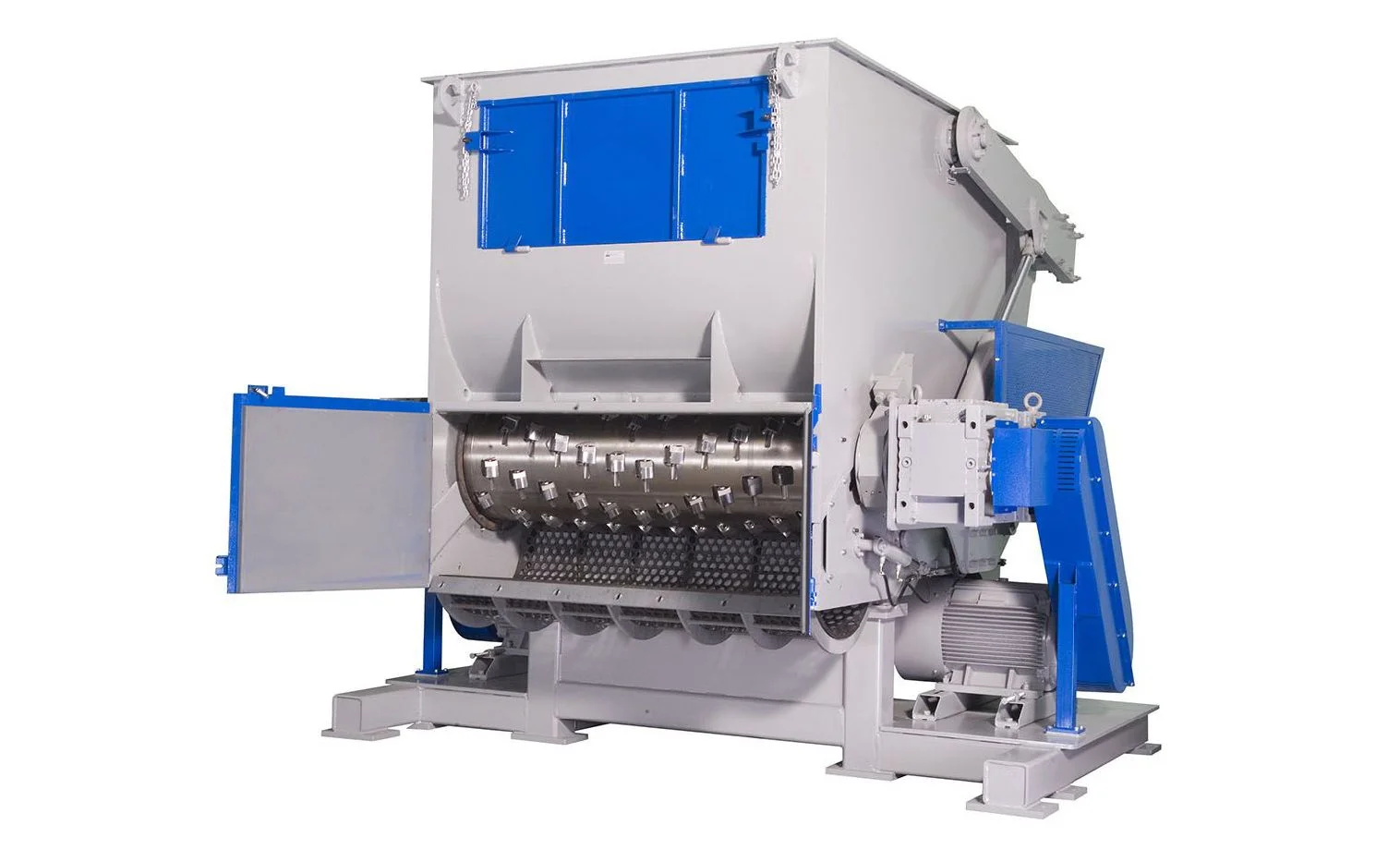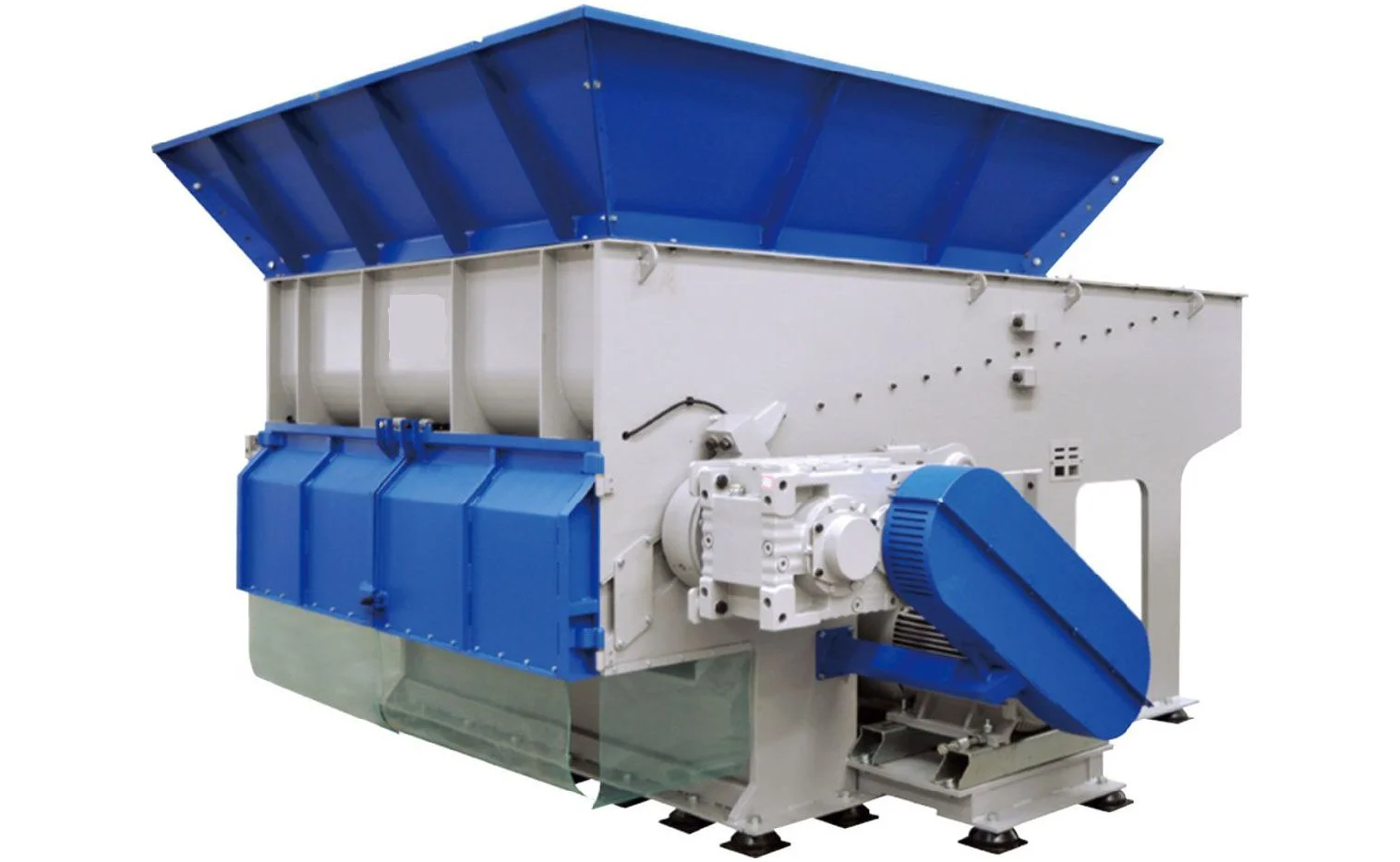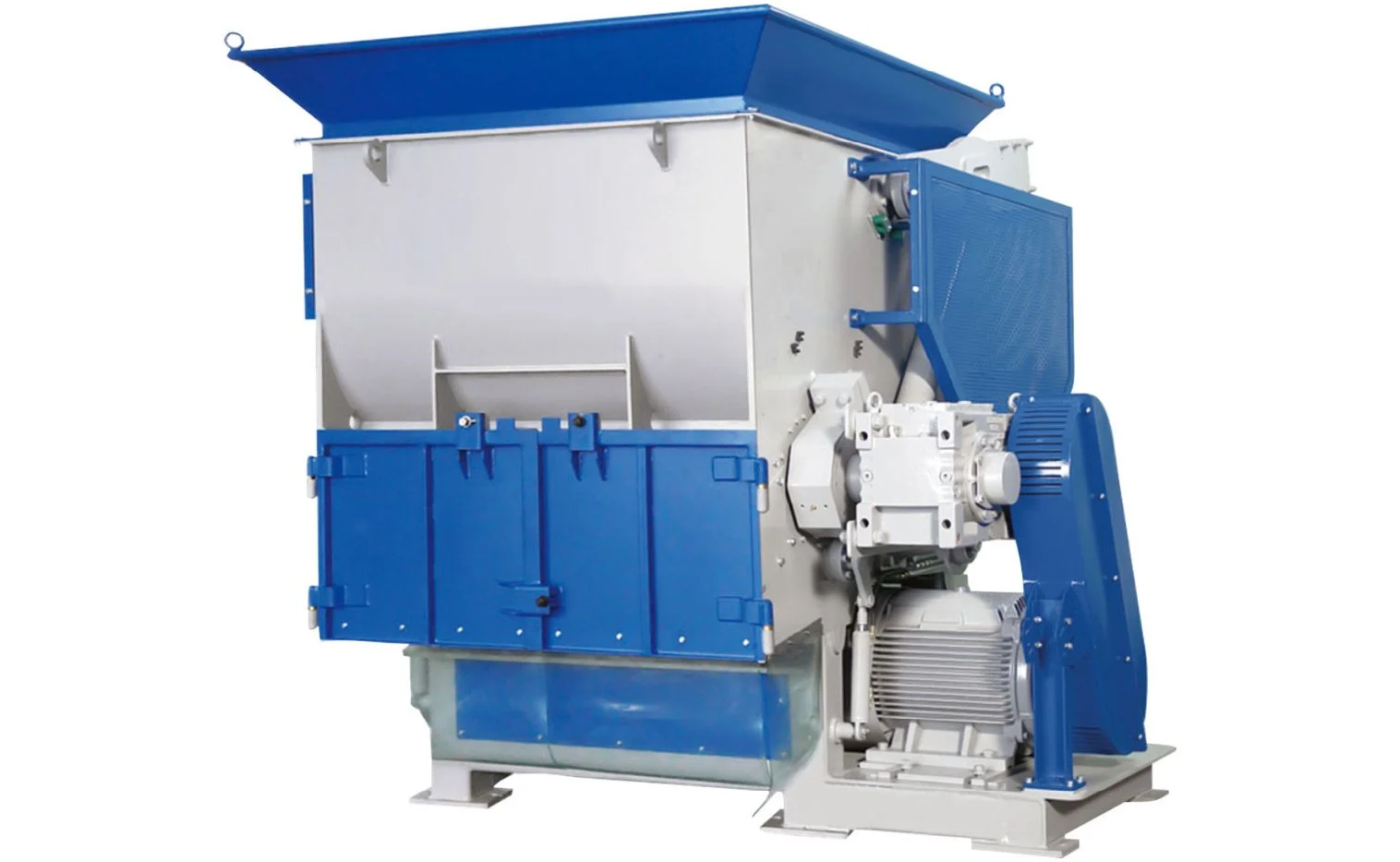
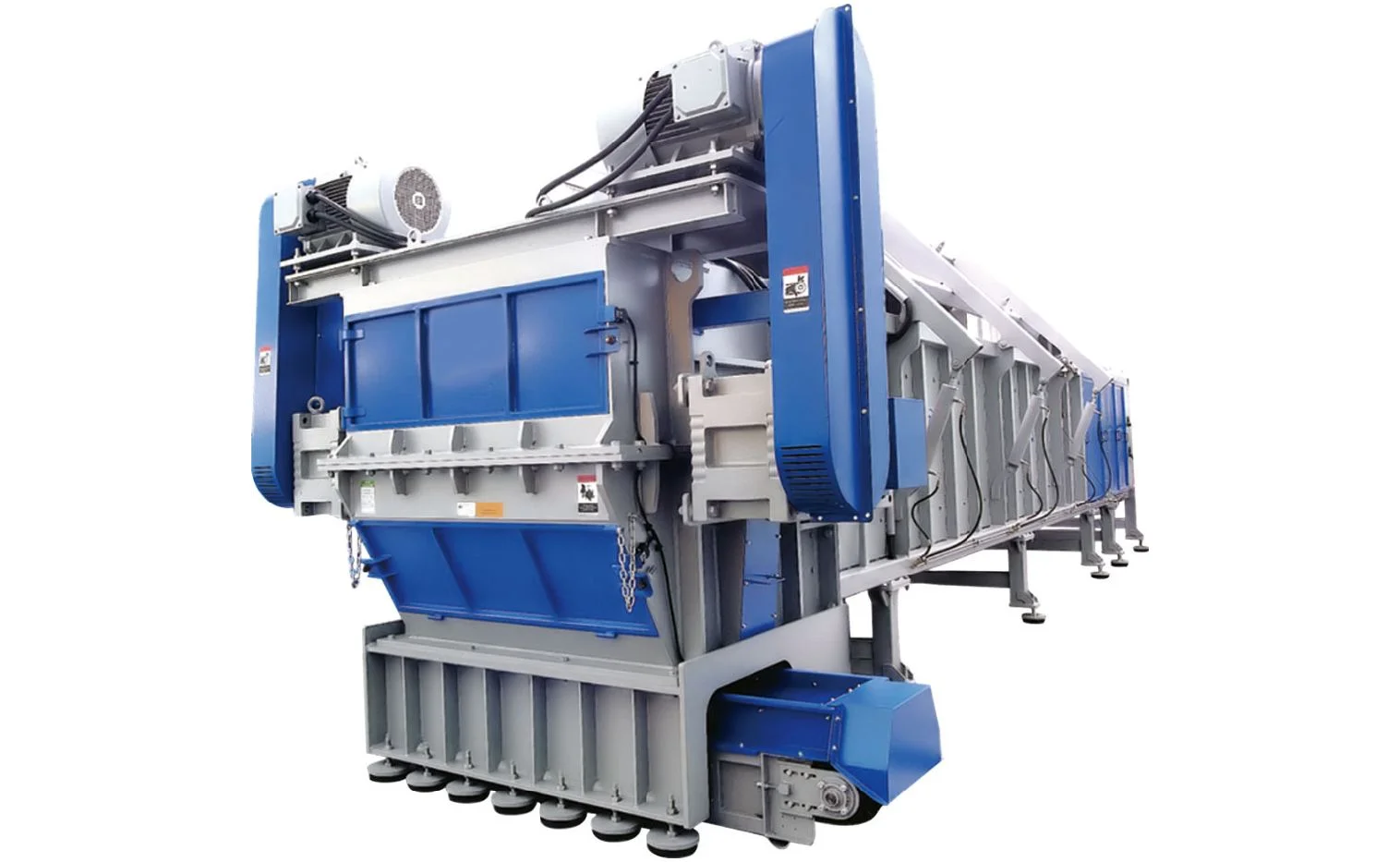
A large diameter plastic pipe is one of the hardest things to recycle, not because the plastic is difficult, but because the shape is. A 30-inch municipal water main or a length of heavy-wall HDPE will not fit the hopper of any standard granulator, and most general-purpose shredders are not built for the hollow geometry, the length, and the wall thickness of big pipe. Hollow pipe resists compression feeding. Forced into a standard shredder at an angle, it can rotate, shift, or jam instead of feeding through the cutting zone. That leaves two bad options: cut the pipe down by hand first, or reject the material entirely. Both cost real money.
The P-Series was built to erase that choice. It is a pipe and profile shredder designed specifically for large diameter pipe, and it takes that pipe directly, with no pre-cutting.
This is the fourth post in our shredder series, covering every shredder we build and who each one is for. This is the specialist that leading pipe manufacturers worldwide reach for when the pipe is simply too big for anything else.
The world’s first, and still the standard
The P-Series is the world’s first single-shaft shredder capable of handling large diameter pipes up to 1200 mm without the need for pre-cutting. That is not a small claim, and it has held up in the field. Since its introduction, the P-Series has become the per se standard for shredding pipe and profile, and it is used by leading pipe manufacturers worldwide. More than 200 installations demonstrate that track record, and the design keeps evolving based on market demand and customer feedback.
What makes it work is the feed system. A long feeding trough accepts pipe lengths up to 6 meters, so full lengths go in without being cut down first. A powerful hydraulic ram then forces the pipe into the rotor at a controlled rate, which is what solves the hollow-pipe feeding problem: instead of letting the pipe rotate and jam, the ram manages the feed rate throughout the cut so the rotor is never starved and never stalled.
What it shreds
The P-Series mainly shreds large diameter pipes, or bundles of smaller pipes and profiles, made of HDPE, PP, and PVC. Because the feed system is so capable, it also handles other bulky material well, including lumps, pallets, and stacked bins. And bundled or nested pipes are part of the design intent, so smaller pipes can be run in groups for throughput rather than one at a time.
It is available in rotor diameters and widths from 800 mm up to 1500 mm, so the machine can be sized to the specific pipe diameter range your facility processes. The combination of advanced controls, low rotor speed, and smooth hydraulics makes it a reliable, easy-to-use system even at this scale.
Who needs one
Pipe manufacturers. Startup lengths, end-of-run cuts, dimensional rejects, and off-spec pipe all need to go somewhere. The P-Series lets a pipe producer reclaim its own large diameter scrap in-house instead of paying to cut it down or haul it away.
Recyclers handling end-of-life infrastructure pipe. The U.S. has hundreds of thousands of miles of plastic pipe mains in the ground, much of it now reaching the end of a 50 to 100 year service life. Processing that material starts with a machine that can actually accept it, and for large diameter pipe that machine is a dedicated pipe shredder.
Profile and bundle processors. Anyone dealing with rigid profile or large volumes of smaller pipe that can be bundled benefits from the trough-and-ram feed that a standard shredder cannot match.
Typical materials and real-world jobs
The P-Series is the large diameter pipe specialist. Here is what it takes on:
| Pipe manufacturers | Startup lengths, off-spec runs, and rejects of PVC, HDPE, and PP pipe |
| Infrastructure recyclers | End-of-life municipal water mains, drainage, and irrigation pipe |
| Profile processors | Rigid profile and bundled or nested smaller pipes |
| Bulk material | Lumps, pallets, and stacked bins, thanks to the trough-and-ram feed |
The P-Series is built for large diameter pipe up to 1200 mm without pre-cutting. Small clean scrap, bottle caps, or textiles are jobs for a granulator or general shredder. After the P-Series, pipe usually feeds a granulator, and PVC that needs powder finishes on a pulverizer.
P-Series at a glance
| Feature | Detail |
|---|---|
| Max pipe diameter | Up to 1200 mm, no pre-cutting required |
| Rotor diameters and widths | 800 mm up to 1500 mm |
| Feed trough | Accepts pipe lengths up to 6 meters |
| Feed system | Powerful hydraulic ram, controlled feed rate |
| Materials | HDPE, PP, and PVC pipe and profile, bundles, lumps, pallets, stacked bins |
| Track record | World’s first for this application, 200+ installations worldwide |
Where the P-Series fits in a pipe recycling line
For large diameter pipe, the P-Series is usually the first stage of a multi-step line. The shredder breaks the pipe down to a manageable size, then the material can feed into a pipe and profile granulator that reduces it to the particle size needed for re-extrusion or sale as recycled material. For PVC applications that need powder rather than regrind, a downstream plastics pulverizer completes a three-stage shred, granulate, pulverize line. The P-Series is the machine that makes the whole line possible, because nothing downstream can run material that could not be shredded in the first place.
P-Series shredder
Pipe granulator
Pulverizer (PVC)
See it in action
Sometimes the easiest way to understand a machine is to watch it run. Our YouTube channel has material demonstrations across the full Virtus lineup, so you can see how different materials feed and process at each stage of size reduction before you ever pick up the phone.
Have large pipe? Send it to us and watch it run
Large diameter pipe is exactly the kind of material where a real test settles the question fast. Ship us a sample of your actual pipe or profile, tell us your diameters, wall thickness, and throughput target, and our Fort Myers testing facility will run it on the P-Series and send back the video results along with a confidential technical analysis. Seeing your own pipe feed and shred is the surest way to size the machine right.
After the sale, you are not on your own
Screens and knives are high-wear parts, and when they need replacing, parts for the P-Series are in stock on Virtus Equipment Direct, our online webstore, so you are not waiting on a quote for a part you already know you need. Our service team handles installation and can commission the machine, train your operators, and set up a maintenance schedule from day one. And if your team works in Spanish, so do we. Nuestro equipo le atiende en espanol, desde la primera llamada hasta la instalacion y el soporte.
Frequently asked questions
How large a pipe can the P-Series handle?
Up to 1200 mm in diameter without any pre-cutting, and the feed trough accepts pipe lengths up to 6 meters. Rotor diameters and widths run from 800 mm to 1500 mm, so the machine is sized to your specific pipe range.
Why can’t a standard shredder handle large pipe?
Hollow pipe resists compression feeding. In a standard shredder it tends to rotate, shift, or jam instead of feeding consistently, which wears components and kills throughput. The P-Series solves this with a horizontal trough and a hydraulic ram that controls the feed rate through the cut.
What happens to the pipe after it is shredded?
Shredded pipe typically feeds a pipe and profile granulator for regrind, and for PVC that needs powder, a pulverizer follows as a third stage. The P-Series is the first step that makes the rest of that line possible.
How large a pipe can the P-Series handle?
Up to 1200 mm in diameter without any pre-cutting, and the feed trough accepts lengths up to 6 meters. Rotor diameters and widths run from 800 mm to 1500 mm, sized to your pipe range.
Why can’t a standard shredder handle large pipe?
Hollow pipe resists compression feeding and tends to rotate, shift, or jam in a standard shredder. The P-Series solves this with a horizontal trough and a hydraulic ram that controls the feed rate through the cut.
What happens to the pipe after it is shredded?
Shredded pipe typically feeds a pipe and profile granulator for regrind, and for PVC that needs powder, a pulverizer follows as a third stage.
Terms worth knowing
A few terms come up constantly when you are speccing this kind of machine. Here they are in plain language:
Feed trough. The long horizontal table that accepts full pipe lengths (up to 6 meters), so pipe goes in without being cut down first.
Hydraulic ram. The powered pusher that forces pipe into the rotor at a controlled rate, solving the hollow-pipe feeding problem.
Single-shaft shredder. One cutting rotor working against fixed counter knives, the design behind the P-Series.
Screen perforation size. The hole diameter that sets the maximum output size before the material moves downstream.
Three-stage line. The shred, granulate, pulverize sequence used to take large pipe all the way to regrind or powder.
Related machines
If this machine is not quite the right fit, these are the neighbors to look at: