Your granulator will tell you when its knives are going. Here is what to listen and look for, and how to decide between sharpening and a new set.
Knives are the part of a granulator that does the actual work, and they are also the part that wears out on a schedule nobody wrote down. They do not fail all at once. They dull gradually, and the machine slowly gets louder, slower and hungrier for power while the regrind gets worse.
Catching dull knives early protects more than regrind quality. A granulator running on worn edges puts extra load on the motor, belts and bearings, and it turns sharpening jobs into replacement jobs. Here are the seven signs we teach operators to watch for at Virtus Equipment.
7 signs your granulator knives are dull
Sharpen or replace?
Most granulator knives are designed to be sharpened several times before they are retired. The question is whether the knife you are holding still has enough life in it.
| Sharpen when | Replace when |
|---|---|
| Edges are rounded or slightly nicked but the knife is otherwise intact | The knife is chipped, cracked or deformed |
| The knife is still above the minimum dimension listed in your operating manual | Previous sharpening has taken the knife to or below its minimum dimension |
| The full set is wearing evenly | The knife was damaged by tramp metal or another foreign object |
| Bed knives and rotor knives can be brought back to a correct gap | The set can no longer be gapped correctly after sharpening |
When you sharpen, follow the grinding angle and procedure in your operating manual, and sharpen rotor knives as a matched set so they stay consistent with one another. Uneven knives mean uneven cutting.
How Virtus Equipment knife designs make this easier
Knife changes are where many maintenance plans fall apart, because a hard knife change is a knife change that gets postponed. Virtus Equipment granulators are designed with that in mind:
- A Series low speed granulators: the knives can be sharpened and do not need adjustment afterward, because the knife profile keeps a constant cutting radius after re-sharpening.
- E, C, H and P Series granulators: knives are adjusted outside the machine, so gaps can be set accurately on the bench instead of inside the cutting chamber.
- Abrasive and filled materials: hard facing and wear-resistant steels are available, and the H Series and C 25-40 tangential granulators use replaceable wear plates.
Changing knives safely
Granulator knives are sharp, heavy and mounted on a rotor that can move even when the motor is off. Treat every knife change as a hazardous energy job.
Keep a spare set on the shelf
The simplest way to shorten knife downtime is to never wait for sharpening. Keep one spare, ready-to-install set per granulator, swap it in, and send the dull set out for sharpening while the machine keeps running. Virtus Equipment Direct stocks OEM knives for Virtus Equipment granulators so your spare set is the right fit the first time.
Machines mentioned in this article
Low Speed Granulators (A Series / LS Series)
Knives keep their cutting gap after re-sharpening
Order OEM knives before you need them
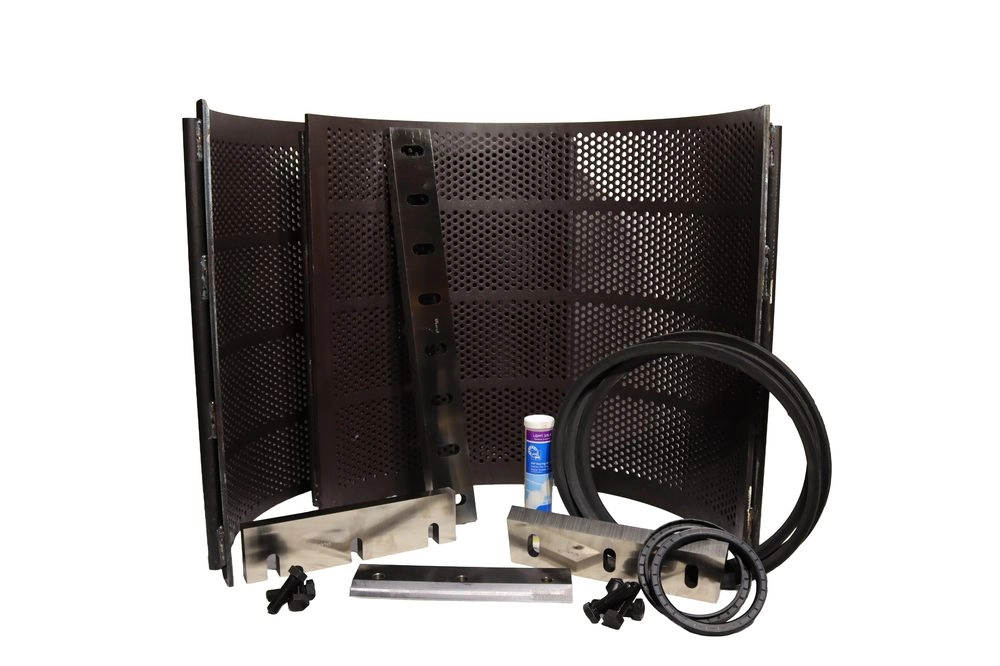
Virtus Equipment Direct carries OEM knives, bed knives, screens and wear parts for Virtus Equipment granulators. Call us if you need help matching a part to your machine.
Frequently asked questions
How often should granulator knives be sharpened?
There is no single interval. It depends on the material, how much you run, how the machine is fed and whether the material is filled or abrasive. Logging knife hours alongside regrind quality is the most reliable way to set your own schedule.
How many times can granulator knives be sharpened?
Until they reach the minimum dimension listed in your operating manual, or until they are chipped, cracked or can no longer be gapped correctly. At that point they should be replaced.
Do I need to reset the knife gap after sharpening?
On most granulators, yes. On Virtus Equipment A Series low speed granulators, the knife profile keeps a constant cutting radius after re-sharpening, so the knives do not need adjustment afterward.
Should I sharpen rotor knives as a set?
Yes. Sharpening a matched set keeps the knives consistent with one another, which keeps cutting even across the rotor.
Where can I buy replacement Virtus Equipment granulator knives?
Virtus Equipment Direct at virtus-equipment.com/direct/ stocks OEM knives, screens and wear parts.