Automotive suppliers produce some of the most varied plastic scrap in manufacturing. Here is how to match each stream to the right size-reduction equipment.
The modern vehicle is a plastics application. According to the American Chemistry Council, the average North American light vehicle contained 428 pounds of plastics and polymer composites in 2025, up 18% from a decade earlier. Plastics now make up more than half of a vehicle’s volume while accounting for less than 10% of its weight.
For the suppliers who mold those parts, that growth comes with a scrap stream: startup shots, sprues and runners, rejected parts, purgings, and large parts that miss a dimensional or cosmetic spec. Much of it is clean, single-resin, post-industrial material with real value if it is handled correctly.
Which plastics show up in automotive scrap?
Reporting on the same American Chemistry Council data, Repairer Driven News listed the leading resins by average pounds per vehicle:
Average pounds per North American vehicle, 2025
Top five resins and composites reported. Source: American Chemistry Council data via Repairer Driven News.
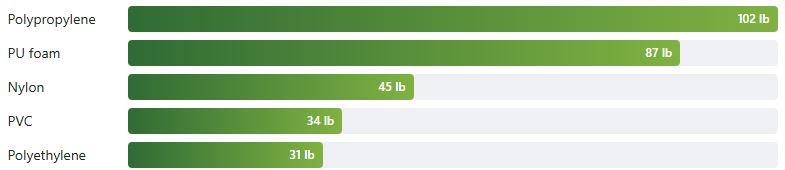
Polypropylene leads because it shows up everywhere: bumper fascias, interior trim, door panels and consoles. Nylon is common in under-the-hood components and is often glass-filled. Each of these resins behaves differently in a granulator, which is why automotive plants rarely get by with one machine for every stream.
Match the scrap stream to the machine
| Scrap stream | Typical challenge | Virtus Equipment fit |
|---|---|---|
| Sprues and runners at the press | Needs to go back into the same press quickly with minimal dust | A Series (LS Series) low speed granulators, built for grinding runners and sprues for immediate reuse |
| Small to mid-size rejected parts | Mixed shapes, steady volume, noise near production | C Series compact soundproofed or E Series economical granulators |
| Large, hollow or awkward parts such as panels, housings and reservoirs | Parts that bridge or bounce in a standard hopper | C 25-40 tangential granulators, whose curved back wall reduces the risk of parts getting stuck,3 or the E 50 for larger hollow parts |
| High-volume, thick-wall parts and bumper fascias | Heavy cutting loads, high throughput | H Series heavy duty granulators, used standalone or as a second stage after a shredder |
| Bulky parts that will not fit a granulator throat | Needs primary reduction first | SG shredder granulator combination, or a G Series or V Series shredder ahead of a granulator |
| Purgings and startup lumps | Solid, dense chunks that can damage a granulator | L 30 lump and purge shredder |
| Scrap tires | Steel-belted rubber, not plastic regrind | T Series tire shredders |
Three automotive-specific challenges
Glass-filled nylon and other reinforced grades
Under-the-hood parts are often molded from glass-filled nylon, and these grades are both abrasive and sensitive to how they are reground. A Western Michigan University study run with automotive supplier Johnson Controls found that tensile strength in glass-filled nylon 6 dropped between virgin material and regrind, and the researchers attributed the loss to shorter glass fiber length rather than lower glass content.
Two takeaways for the plant floor: control the ratio of regrind going back into critical parts, and protect the granulator from abrasive wear. Virtus Equipment offers hard facing and wear-resistant steels for abrasive or filled materials, and the H Series includes easily replaceable wear plates.
Painted, plated and multi-material parts
A rejected bumper fascia that has already been painted is not the same material as a clean molded one. The same goes for parts with overmolded seals, metal inserts, clips or labels. Keep these streams separate from clean scrap so they do not contaminate regrind headed back to the press, and plan for metal detection or separation where inserts are common.
Foam and seating materials
Polyurethane foam is the second-largest polymer by weight in the vehicle, but it is not a material that goes back into an injection molding press as regrind. Treat it as its own stream with its own outlet rather than mixing it with thermoplastic scrap.
Where the scrap is generated matters
An automotive plant usually needs a mix of approaches. Beside-the-press granulators recover sprues and runners right where they are produced, which keeps material clean and identified. A central granulation area handles rejected parts and larger scrap from several presses. Our article on beside the press versus central granulation walks through how to decide which material goes where.
Test before you buy
Automotive scrap varies too much for a spec sheet to tell the whole story. A painted fascia, a glass-filled bracket and a soft-touch interior panel can all behave differently in the same machine. Virtus Equipment material testing runs your actual parts so you can see the regrind, the throughput and the fines before you commit to a machine.
Machines mentioned in this article
Low Speed Granulators (A Series / LS Series)
Sprues and runners straight back into production
Send us your automotive scrap
Virtus Equipment will run your actual parts through the right machine and show you the results before you buy.
Frequently asked questions
How much plastic is in a car?
The American Chemistry Council reports that the average North American light vehicle contained 428 pounds of plastics and polymer composites in 2025.
Can rejected bumper fascias be reground?
Yes. Unpainted fascias are typically clean polypropylene-based material and can be granulated, often with a heavy duty granulator or a shredder ahead of a granulator for very large parts. Painted fascias should be kept separate from clean scrap.
Does regrinding glass-filled nylon reduce strength?
It can. A Western Michigan University study with Johnson Controls found tensile strength dropped between virgin glass-filled nylon 6 and regrind, which the researchers attributed to shorter glass fibers. Controlling the regrind ratio in critical parts is common practice.
What machine handles sprues and runners from automotive molding?
Beside-the-press low speed granulators, such as the Virtus Equipment A Series, are built for grinding runners and sprues for immediate reuse.
Can Virtus Equipment test our automotive parts?
Yes. Virtus Equipment material testing runs your actual scrap so you can evaluate regrind quality and throughput before purchasing.