Seven common causes of dusty regrind, how to tell which one you have, and what to fix first.
Good regrind looks a lot like the pellets it came from: consistent chips, very little dust, and nothing that clings to the inside of the bin. When a granulator starts throwing off fines, the problem rarely announces itself all at once. Dust builds in the dust collector, the hopper starts to bridge, the molding press feeds a little less consistently, and someone eventually asks why the regrind looks like flour.
The good news is that fines almost always come from a short list of causes, and most of them are mechanical problems you can find and fix in a single maintenance window. This guide walks through the seven we see most often at Virtus Equipment, in the order we would check them.
Why fines are worth fixing
Fines are not just a housekeeping issue. They affect material value, process consistency and plant safety.
- They carry measurable weight. In a Western Michigan University study of glass-filled nylon regrind, co-authored with Johnson Controls, aspiration removed roughly 8% of the regrind by weight as fines. That is material you paid for that either ends up in a dust bag or causes trouble in the press.
- They can lower part performance. In the same study, molded samples made from 100% fines showed lower tensile strength than samples made from the heavier regrind particles.
- They cause handling problems. The researchers found that removing fines produced regrind with fewer problems from static, dust and water absorption.
- Plastic dust is a combustible dust. OSHA lists plastics among the materials that can be explosible when finely divided and suspended in air. Keeping fines under control is part of good housekeeping in any size-reduction room.
The 7 most common causes of granulator fines
1. Dull knives
A sharp knife cuts plastic. A dull knife crushes, tears and smears it, and every one of those actions produces dust. Dull knives are the single most common cause of rising fines, and they usually bring company: lower throughput, a louder machine and a motor that works harder than it used to.
What to check: With the machine locked out, look at the cutting edges on both the rotor knives and the bed (stator) knives. Rounded edges, nicks and chips all point to knives that need sharpening or replacement. Our companion guide, Dull Granulator Knives: 7 Signs It Is Time to Sharpen or Replace Them, covers this in detail.
2. A cutting gap that has opened up
Even sharp knives make fines if the gap between the rotor knives and the bed knives is too wide. Instead of a clean scissor cut, the plastic gets pinched and folded through the gap. Gaps open up over time as knives are sharpened, and they can shift if a knife is not seated or torqued correctly.
What to check: Measure the gap against your operating manual. On Virtus Equipment E, C, H and P Series granulators, knives are adjusted outside the machine, which makes it easier to set them accurately. On the low speed A Series, the knife profile keeps a constant cutting radius after re-sharpening, so the original cutting gap is maintained without readjustment.
3. Screen problems
The screen decides when a particle is small enough to leave the cutting chamber. If holes are partially plugged, or if the screen is undersized for the material and throughput you are asking of it, material stays in the chamber longer and gets cut again and again. Every extra pass turns good regrind into smaller particles and dust.
What to check: Look for blinded or packed holes, warping, cracks and worn edges. Then confirm the hole size is right for the job. Virtus Equipment granulators are specified with minimum screen sizes from more than 5 mm on the A Series to more than 6 mm or 8 mm on the E, C, H and P Series. If you are running a smaller screen than your application needs, that alone can explain a dust problem.
4. Overfeeding the cutting chamber
Dumping a full tote into a granulator that was sized for steady feeding packs the chamber. Material recirculates, heat builds, and particles are re-cut until they pass the screen. Overfeeding also dulls knives faster, which compounds the problem.
What to check: Watch how the machine is actually fed during a normal shift. A conveyor, metered feeding or a simple change in how operators load the hopper often reduces fines noticeably.
5. Heat in the cutting chamber
Plastic softens as it warms. Softened material smears rather than fractures cleanly, and it can build up on knives and screens, which restarts the cycle of recirculation. Heat usually comes from the causes above (dull knives, overfeeding, a blocked screen), so treat it as a symptom to trace back rather than a root cause on its own.
6. Brittle materials on the wrong machine
Some materials shatter instead of cutting. General purpose polystyrene, acrylic and many glass-filled grades fracture into small pieces on impact. Running them through a fast, aggressive rotor can produce a lot of dust no matter how well the machine is maintained.
What to consider: A slower cut is often the answer. Virtus Equipment A Series low speed granulators run at 150 rpm with a staggered rotor that makes individual cuts, increasing cutting torque. For heavier work, the H Series heavy duty granulators include a removable deflector wedge that adjusts how aggressive the rotor is, and the catalog notes a very low percentage of fines. The P Series pipe and profile granulator is likewise listed with a very low percentage of fines.
7. Worn wear parts and abrasive materials
Filled and reinforced materials wear knives, chamber surfaces and screens faster than unfilled resin. As those surfaces wear, cutting geometry drifts and fines rise. Virtus Equipment offers hard facing and wear-resistant steels for abrasive or filled materials, and replaceable wear plates are standard on the H Series and C 25-40 tangential granulators.
Quick diagnostic table
| What you see | Most likely cause | Check first |
|---|---|---|
| Fines rising gradually over weeks | Dull knives or an opening cutting gap | Knife edges and gap measurement |
| Fines plus lower throughput and higher motor load | Dull knives or overfeeding | Knife condition, then feeding method |
| Fines appeared right after a knife change | Gap set incorrectly or knives not seated | Gap, knife seating and bolt torque per the manual |
| Warm regrind, smearing, buildup on the screen | Material recirculating in the chamber | Screen condition and size, feed rate |
| Dust only on one specific material | Brittle material on an aggressive cut | Rotor speed and rotor style for that material |
| Fines plus visible wear in the chamber | Abrasive or filled material | Wear plates, knives and screen wear |
How to measure your fines
You do not need a lab to keep an eye on regrind quality. Pull a sample from the same point in the process on a regular schedule, shake it through a fine sieve or simply compare it against a reference sample in a clear container, and record the result next to the knife hours. When the trend starts moving, you will see it long before an operator complains.
Safety first. Always lock out and tag out a granulator before opening the cutting chamber, inspecting knives or changing a screen. OSHA’s hazardous energy standard, 29 CFR 1910.147, applies to this kind of servicing work.
Fix the parts first, then look at the machine
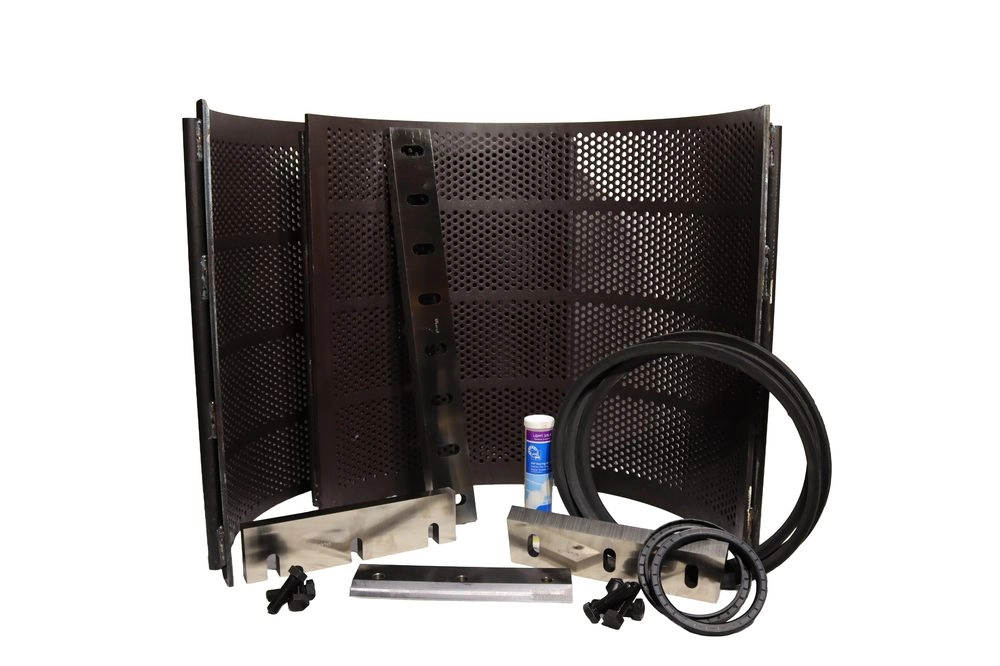
Most fines problems are solved with sharp knives, a correct gap and a clean screen of the right size. Virtus Equipment Direct stocks OEM knives, screens and wear parts for Virtus Equipment granulators, so you can get the machine back to spec quickly.
If the knives are fresh and the gap is right but a material still turns to dust, the issue may be the match between the material and the machine. That is exactly what our material testing is for: we run your actual scrap and show you what the regrind looks like before you buy anything.
Machines mentioned in this article
Low Speed Granulators (A Series / LS Series)
150 rpm staggered rotor for sprues, runners and brittle materials
H Series Heavy Duty Granulators
Adjustable deflector wedge and a very low percentage of fines
P Series Pipe and Profile Granulators
Angled rotor with a very low percentage of fines
C Series Compact Soundproofed Granulators
Knives adjusted outside the machine for accurate gaps
Need knives or screens to get back to spec?
Virtus Equipment Direct ships OEM knives, screens and wear parts for Virtus Equipment granulators. Not sure what you need? Our team can help you diagnose it.
Frequently asked questions
What are fines in plastic regrind?
Fines are the dust and very small particles produced during granulation. They are much smaller than the target regrind size and behave differently in drying, conveying and feeding.
Can fines be used in my process?
Sometimes, in small amounts, but they can cause feeding problems, static and dust. In one university study on glass-filled nylon, samples molded from 100% fines had lower tensile strength than samples from heavier regrind particles.
What is the fastest way to reduce granulator fines?
Lock out the machine, then check knife sharpness and the cutting gap. Dull knives and a gap that has opened up are the two most common causes, and both are fixed during a normal maintenance window.
Does screen size affect fines?
Yes. A screen that is too small for the material or throughput keeps material in the chamber longer, so it gets re-cut into smaller particles. A plugged screen has the same effect.
Where can I buy replacement granulator knives and screens?
Virtus Equipment Direct stocks OEM knives, screens and wear parts for Virtus Equipment granulators at virtus-equipment.com/direct/.
Keep reading
- Dull Granulator Knives: 7 Signs It Is Time to Sharpen or Replace Them
- Granulator Maintenance: The Checks That Prevent the Breakdowns That Cost You the Most
- Why a Low Speed Granulator Might Be the Smartest Buy on Your Plant Floor
- Virtus Equipment Direct: OEM Knives, Screens, and Wear Parts, Shipped Same Day