Every injection molding shop has the same pile. Sprues and runners in gaylords along the wall, clean single-resin material that was already bought and paid for, waiting on a hauler or a regrind vendor. The EPA reports a U.S. plastics recycling rate of only about 9 percent, and while that figure tracks consumer waste, clean in-house production scrap is some of the easiest material of all to keep out of a landfill..
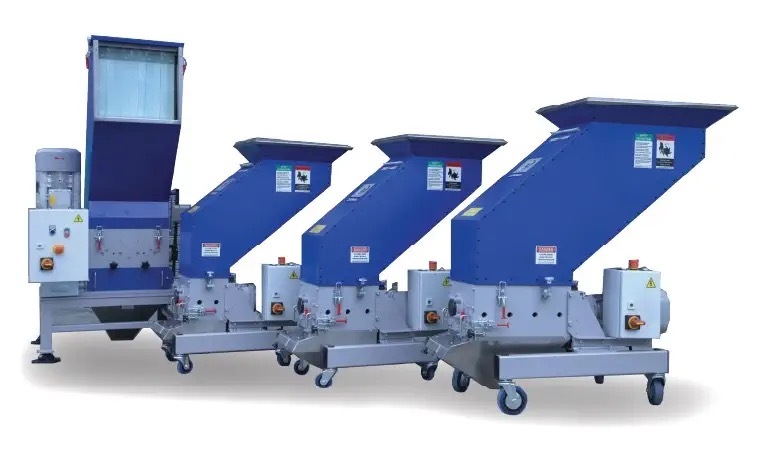
A beside the press granulator closes that loop right at the machine. If you want the full rundown on how low speed granulation works and why it protects material quality, we covered that in our guide to slow speed granulators. This post picks up where that one leaves off. You know you want one. Now, which one?
First, is a beside the press granulator even the right machine?
Quick gut check before we compare models. A beside the press unit is built for a steady diet of small, clean, in-line scrap fed a piece at a time. If your scrap looks like any of the following, you are in the right place:
- Sprues and runners in PP, PE, ABS, PC, nylon, and most engineering resins
- Small rejected injection molded parts
- Blow molding tails, flash, and small hollow parts
- Thin-walled parts small enough for the feed opening
If instead you are staring at purge lumps, thick pipe, film bales, or drums, stop here. That work belongs to a heavy duty central granulator or a shredder, and we will cover both later in this series. Feeding oversized material into an undersized machine is the fastest way to burn out a granulator and void the goodwill of your maintenance team.
Which shop are you?
The molder with a robot already on the press. This is the textbook fit. Your sprue picker drops runners straight into the hopper, the granulator grinds them, and a blower sends regrind back to the hopper loader. Material never touches the floor.
The blow molder with tails and flash. Same closed loop, different scrap. As long as the parts fit the feed opening, a low speed granulator turns your trim stream back into usable resin between shifts instead of into a disposal invoice.
The medical or cleanroom molder. You care about two things most grinders are bad at: dust and noise. Low speed cutting produces very little of either, which is why these machines show up next to presses running medical components and electronics.
The small processor buying their first grinder. Plenty of startups run an LS 30 as their only granulator for the first few years. Its heavier build lets it double as a small central granulator when total volume is modest and a full central setup is not in the budget yet.
Typical materials and real-world jobs
Because the same machine shows up in very different shops, here is what actually goes into a beside the press granulator on a typical day:
| Injection molders | PP, PE, ABS, PC, and nylon sprues and runners; small rejected parts; bottle caps and closures from cap molding |
| Blow molders | Bottle tails and flash, small hollow parts, trimmed necks |
| Medical and cleanroom | Precision components and electronics housings where low dust and low noise matter |
| Packaging | Thin-walled parts and lids fed a piece at a time |
Bottle caps are a good example of where a low speed granulator shines. They are small, clean, single-resin, and generated in high counts, exactly the closed-loop scrap this machine is built to turn back into usable regrind. Bulky, hollow, or heavy items like large bottles, crates, pipe, purge lumps, or textiles such as denim jeans are not this machine’s job; those belong to a tangential granulator, a heavy duty central granulator, or a shredder, which we cover elsewhere in this series.
LS 18 vs LS 30 at a glance
| LS 18 Series | LS 30 Series | |
|---|---|---|
| Rotor diameter | 180 mm | 300 mm |
| Working widths | 180 to 430 mm | 400 to 800 mm |
| Built for | Sprues, runners, small thin-walled parts | Thicker, stronger, and glass-filled material, larger parts |
| Typical home | Next to a single press with a robot feed | Serving a press cell, or working as a small central granulator |
| Knife servicing | Both series use knives that resharpen with no adjustment needed afterward, and both are driven by a geared motor coupled directly to the rotor | |
How the two stack up by material
The bars below show a relative fit, not a throughput spec. Real numbers depend on your part geometry and resin, which is exactly what our test lab measures for you.
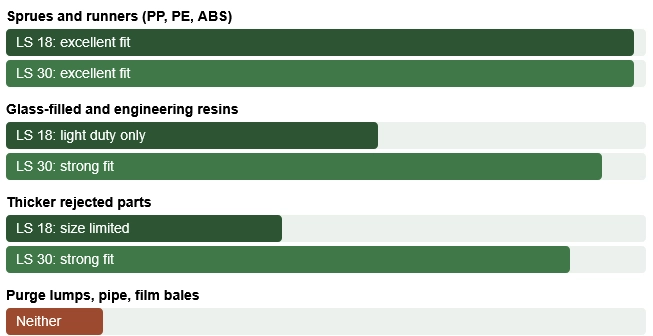
These call for a shredder or heavy duty central granulator
Three questions that size the machine
You can get most of the way to the right model with a notepad and one shift of observation. First, how many pounds per hour will feed the machine? Weigh the runners from one cycle and multiply across the presses involved. Second, what is the single largest piece going in? The feed opening must accept it whole, because pre-cutting scrap by hand is a labor cost and a safety problem you should never accept. Third, where does the regrind go next? If the answer is straight back to the press, spec the machine with a blower and a suction bin or bag-filling adapter so the loop actually closes.
Both series accept a range of sound-absorbing hoppers and base frames, so they integrate with most injection molding machines and robots without custom fabrication.
See it in action
Sometimes the easiest way to understand a machine is to watch it run. Our YouTube channel has material demonstrations across the full Virtus lineup, so you can see how different plastics feed and cut at each stage of size reduction before you ever pick up the phone.
Or skip the guesswork and let us grind your material
Here is the part our competitors do not lead with. You do not have to be sure. Send a box of your actual sprues, parts, or scrap to our testing facility, tell us roughly how much you process and what you plan to do with the regrind, and we will run it through the machines and send back real results with a straight recommendation. Sometimes that recommendation is a smaller machine than you expected. We would rather you buy the right machine than the big one.
After the sale, you are not on your own
Knives wear. Screens wear. When they do, replacement knives, screens, and wear parts for our full lineup are in stock on Virtus Equipment Direct, our online webstore, so you are not waiting on a quote for a part you already know you need. Our service team handles installation and can commission the machine, train your operators, and set up a maintenance schedule from day one. And if your team works in Spanish, so do we. Nuestro equipo le atiende en español, desde la primera llamada hasta la instalación y el soporte.
Frequently asked questions
Can one beside the press granulator serve more than one press?
Yes, if the presses are close together and the combined runner weight stays inside the machine’s capacity. The LS 30’s wider rotor options make it the usual pick for a multi-press cell. When several presses run different resins that must stay separated, a dedicated unit per press keeps the regrind clean.
What happens to regrind quality if I oversize the machine?
Oversizing wastes energy and floor space, but the bigger risk is undersizing, which forces the machine to tear material rather than cut it. Right-sizing is exactly what a material trial answers in an afternoon.
Do I need a robot to feed a low speed granulator?
No. Robot feeding is the cleanest setup, but hand feeding works fine for lower volumes. The feed opening just needs to accept your largest piece whole.
What materials does a beside the press granulator handle best?
Clean, single-resin in-line scrap: sprues and runners in PP, PE, ABS, PC, and nylon, plus small rejected parts, blow molding tails and flash, and bottle caps and closures. Bulky, hollow, or contaminated material belongs to a tangential granulator, a heavy duty granulator, or a shredder instead.
Can it grind bottle caps and closures?
Yes. Bottle caps are an ideal fit, small, clean, single-resin, and generated in high counts, exactly the closed-loop scrap a low speed granulator turns back into usable regrind. Denim, tires, pipe, and other bulky or tough material need a shredder first.
How loud is a low speed granulator?
Quiet enough to stand next to and hold a conversation. The low rotor speed and scissor-like cut produce far less noise and dust than a conventional high-speed grinder, which is why these machines work well in medical and clean room settings.
Granulator terms worth knowing
A few terms come up constantly when you are speccing a beside the press granulator. Here they are in plain language:
Rotor knives and bed knives. The rotor knives (sometimes called fly knives) are the moving blades on the rotor. They shear material against the stationary bed knives, and that scissor action is what actually cuts the plastic.
Blade gap. The precise clearance between the rotor knives and the bed knives. Set it correctly and you get clean, uniform granules; let it drift and you get ragged cuts and more fines.
Fines. The undersized, dust-like particles mixed into the regrind. Too many fines cause feeding and quality problems downstream. Low speed cutting is one of the best ways to keep fines to a minimum.
Staggered rotor. A rotor with the knives offset along its length so the cut happens progressively rather than all at once. That gives a smoother, quieter, scissor-like cut, which is a big part of why the LS Series runs so quietly.
Regrind. The granulated output itself, blended back in with virgin resin at a controlled ratio and fed straight back into production.
Related machines
If a beside the press granulator is not quite the right fit, these are the neighbors to look at:
- C-Series compact soundproofed granulators when noise and floor space are the main constraints
- Tangential granulators for bulky, hollow parts like bottles and crates
- H-Series heavy duty granulators for thick-walled parts and higher throughput
- L 30 lump and purge shredder when the scrap is purge blocks and dense lumps