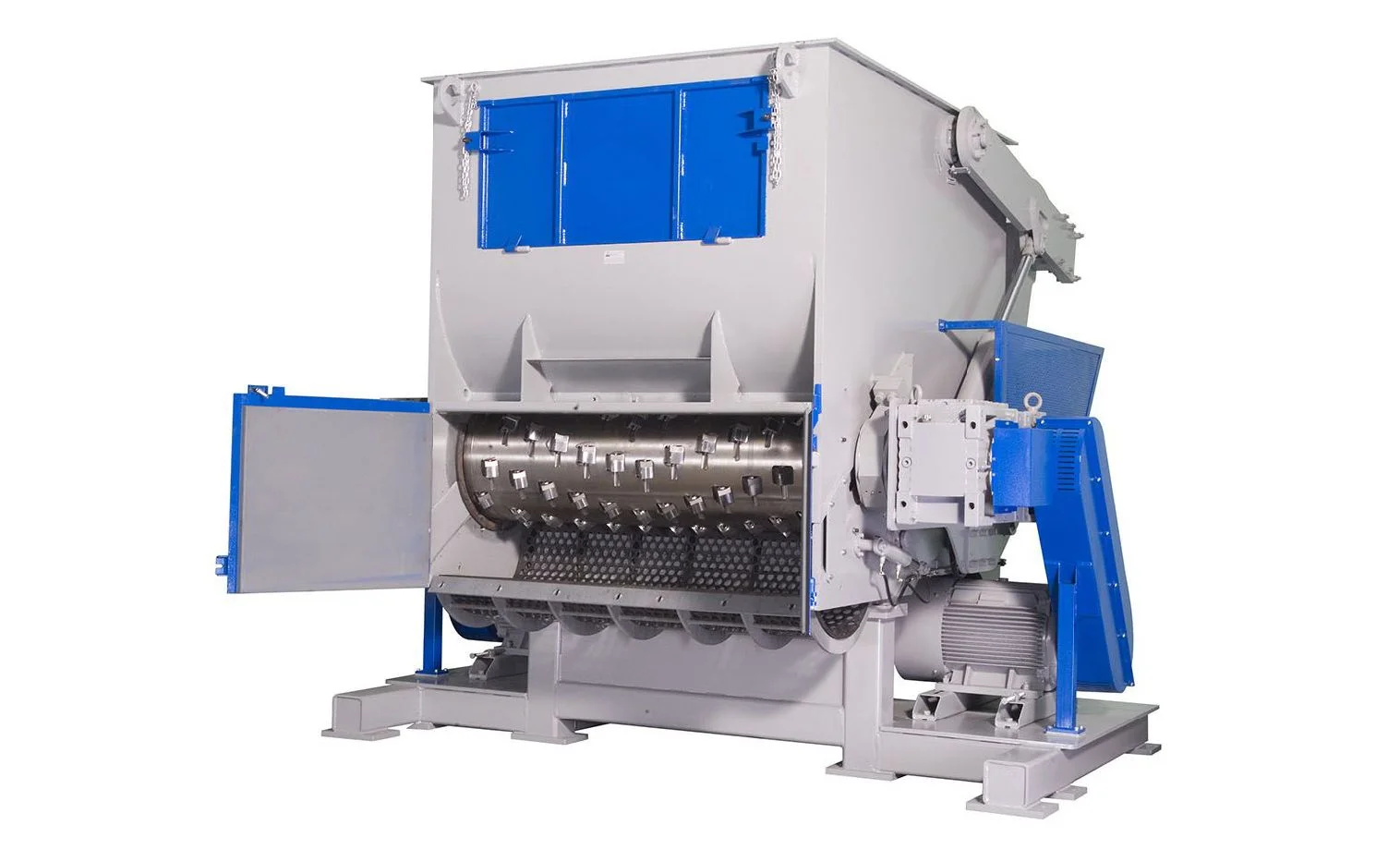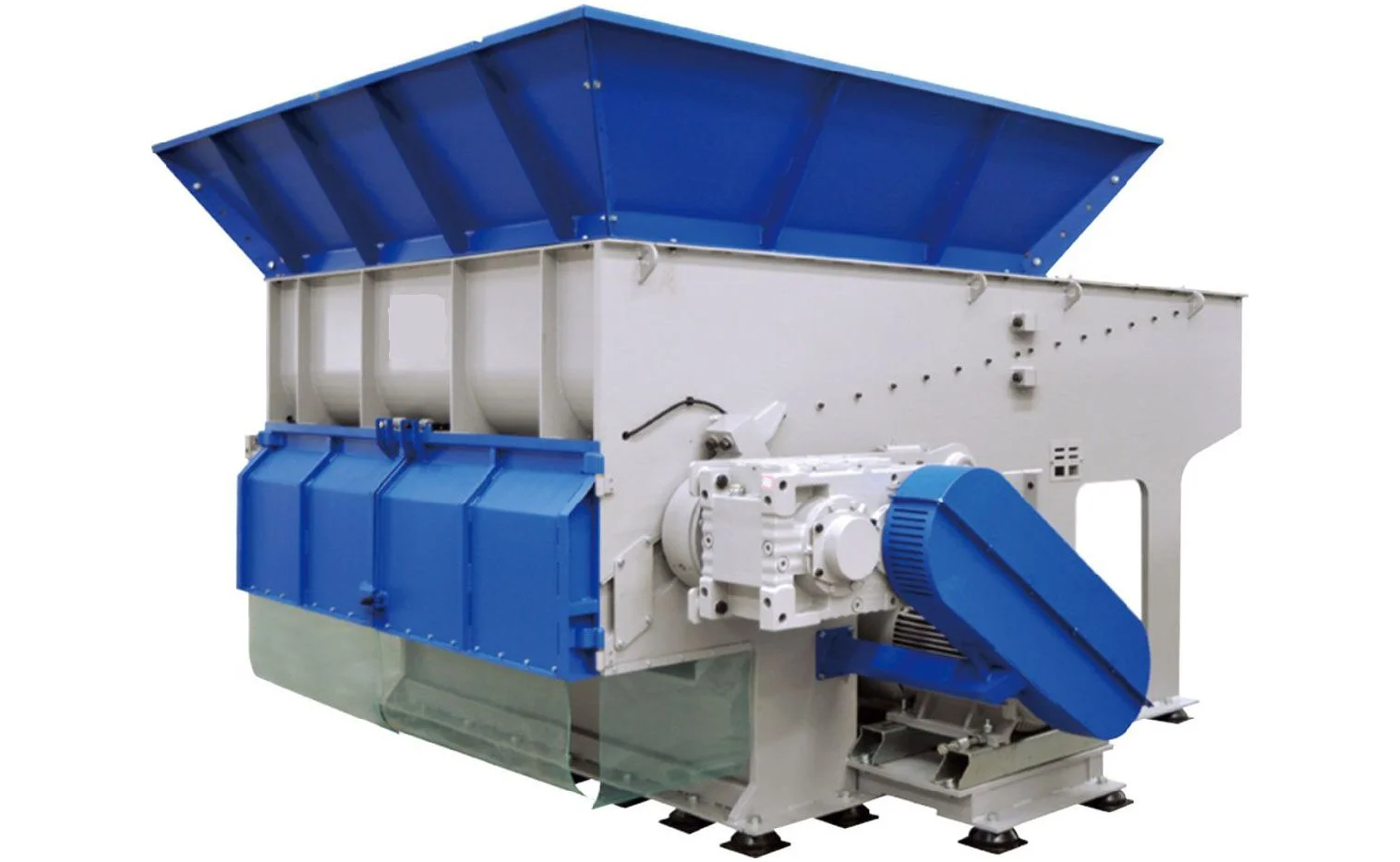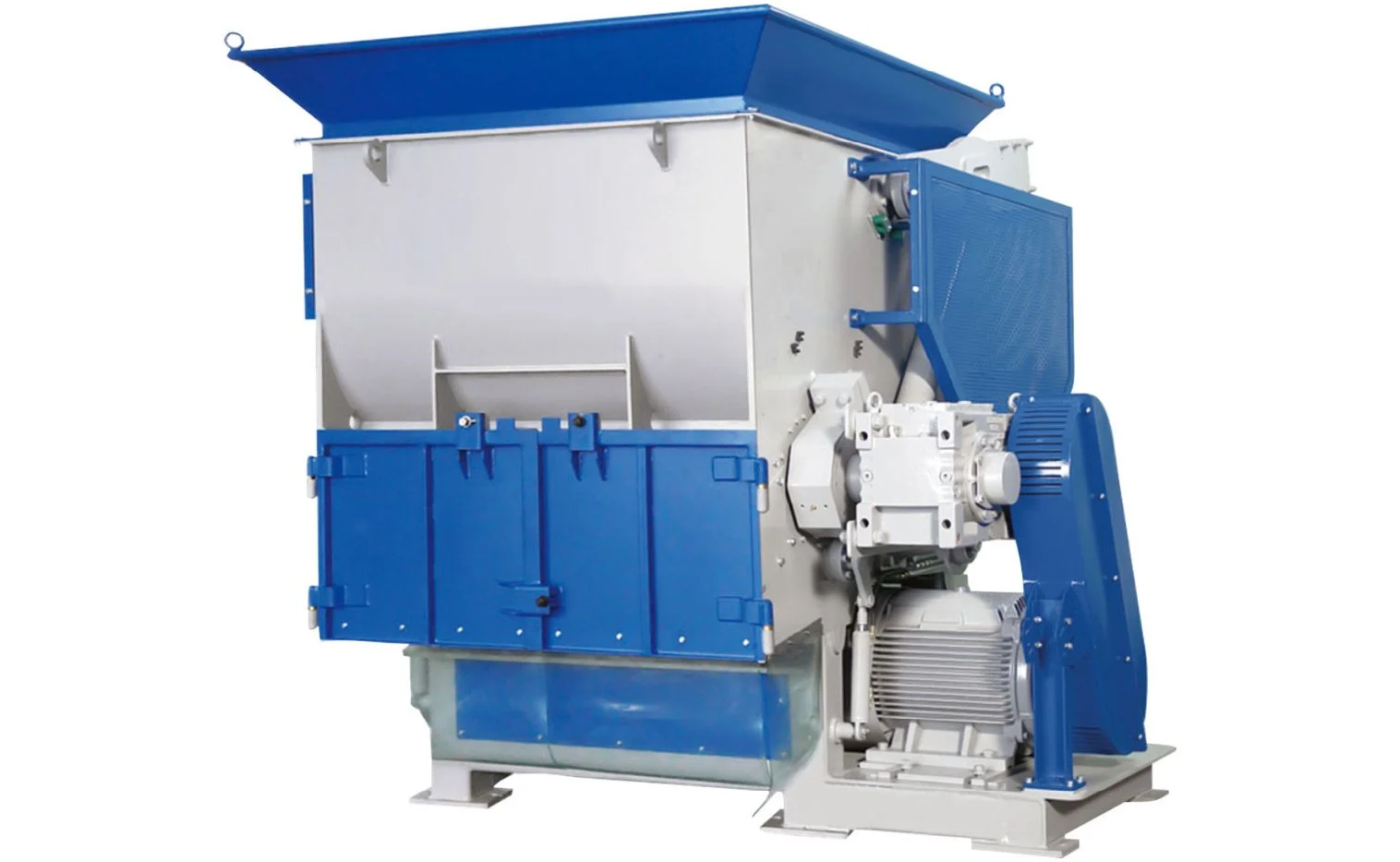
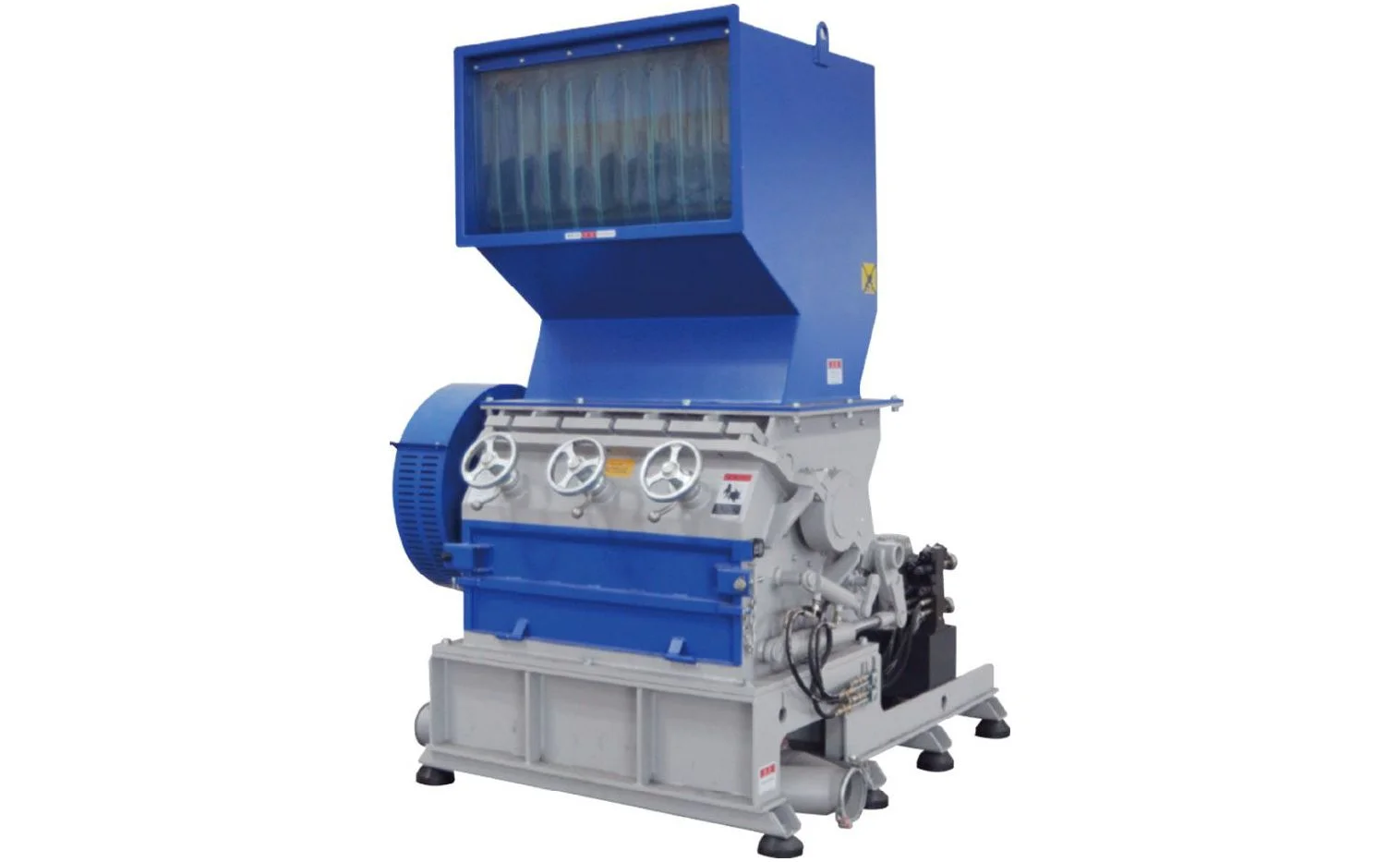
Not every shop needs a soundproofed enclosure, and not every shop needs an industrial heavy duty granulator built for around-the-clock purge processing. A lot of operations sit right in the middle. They have real volume, they want good regrind, they care about price, and they do not want to overbuy. That middle ground is exactly where the E-Series economical granulators live.
The E-Series is the value line, and value here does not mean stripped down. It means you pay for the cutting performance and durability that matter, without the extras a given job does not need. The same machine family can sit beside a press, handle medium-volume in-house recycling, or run as a central granulator, which is what makes it such a flexible first serious granulator for a growing shop.
This is the fourth post in our series covering every granulator we build and who each one is for. It follows the A-Series low speed granulators and the C-Series soundproofed granulators. If your priority is getting the most capability per dollar, this one is for you.
What makes it economical without being cheap
The cost savings in the E-Series come from a focused, no-frills design, not from cutting corners on the parts that determine regrind quality and machine life. Every E-Series machine uses a completely welded cutting chamber paired with V-cut rotor technology, and that V-cut is the same regrind-quality technology found across the Virtus granulator line. It produces clean, uniform granules with a low percentage of fines, which is what lets you blend regrind back into virgin resin without downstream problems.
Maintenance is where the design really pays you back. The rotor and stator knives are pre-set outside the machine on a supplied fixture before installation, so you are not making awkward adjustments while reaching into the cutting chamber. Combined with quick access for knife and screen changes, that keeps changeovers fast and downtime low, which is exactly what a cost-conscious operation needs.
Three models, from beside the press to central
The E-Series scales across three models, and the jump from one to the next is really about how big and voluminous your parts get.
E 30, the entry point. The E 30’s cutting geometry is built for grinding small, thin-walled, or hollow parts. It is the natural starting machine for a shop moving up from a small beside-the-press grinder to something with more capability.
E 50, the step up. The E 50 takes on bigger hollow parts and more material. This is the middle choice for an operation whose volume has grown past what a small machine can comfortably keep up with.
E 70, the economical central granulator. The E 70 is built to grind voluminous material and works as a central granulator. Its redesigned base makes it very sturdy while keeping the cutting chamber easy to reach for cleaning and maintenance. If you want central-granulator capability without stepping all the way up to a heavy duty industrial machine, this is the model.
Typical materials and real-world jobs
The E-Series spans a lot of roles, so its material range is broad. Here is what typically feeds one:
| Startups and small processors | Sprues, runners, and small thin-walled parts (E 30) as a first serious granulator |
| Growing molders | Bigger hollow parts and higher volumes (E 50) |
| In-house recyclers | Voluminous material running through the E 70 as a central granulator |
| Bottle and cap producers | Bottle caps, closures, and light containers in medium volume |
The E-Series is the value pick for medium-volume recycling. Thick-walled purge, abrasive or contaminated streams, and nonstop industrial duty are better matched to an H-Series heavy duty granulator, and bulky or tough feedstock like pipe, tires, or textiles needs a shredder first.
E 30 vs E 50 vs E 70 at a glance
| E 30 | E 50 | E 70 | |
|---|---|---|---|
| Primary role | Beside the press, medium volume | Medium to higher volume | Central granulator |
| Best for | Small, thin-walled, hollow parts | Bigger hollow parts | Voluminous material |
| Notable | Cost-effective entry machine | Balanced middle choice | Redesigned sturdy base |
| Shared across the line | Rotor diameters run from 300 mm to 700 mm in widths from 300 mm to 1400 mm. Every model uses a completely welded cutting chamber, V-cut rotor technology, and knives pre-set outside the machine on a fixture. | ||
Where the E-Series fits against the rest of the line
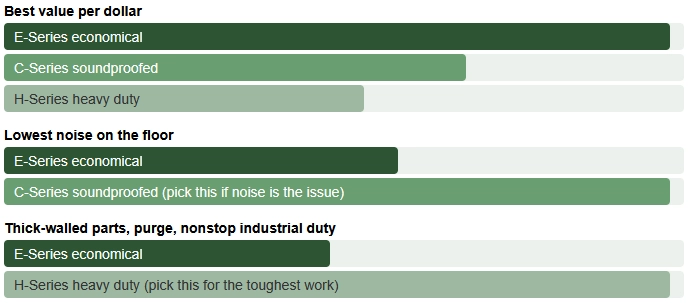
The E-Series is the value option, so the honest way to choose is to know when a different family is worth the extra spend. This chart is not about which machine is better. It is about matching the machine to what actually matters for your operation.
How to pick your E-Series model
Start with your largest and most voluminous part, since that sets the floor for which model you need. Small thin-walled and hollow parts point to the E 30. Bigger hollow parts move you to the E 50. Voluminous material or a genuine central-granulator role puts you at the E 70. Then sanity-check against your volume. The E-Series is happy running medium-volume in-house recycling all day, but if you are feeding thick-walled purge or running an abrasive, contaminated stream around the clock, that is a signal to look at the heavy duty H-Series instead, which we cover later in this series.
See it in action
Sometimes the easiest way to understand a machine is to watch it run. Our YouTube channel has material demonstrations across the full Virtus lineup, so you can see how different materials feed and process at each stage of size reduction before you ever pick up the phone.
Not sure how far up the range to go? Let us test your material
Buying too much machine wastes money and buying too little wastes time, and the line between an E 50 and an E 70 is not always obvious from a spec sheet. That is what our testing facility is for. Send a box of your actual parts and scrap, tell us your volume and what you want the regrind to become, and we will run it and send back a confidential technical analysis with real results. We record the test too, so you can watch your own material go through. If the economical answer really is the right answer, we will show you the proof.
After the sale, you are not on your own
Screens and knives wear, and when they do, replacement knives, screens, and wear parts for the E-Series are in stock on Virtus Equipment Direct, our online webstore, so you are not waiting on a quote for a part you already know you need. Our service team handles installation and can commission the machine, train your operators, and set up a maintenance schedule from day one. And if your team works in Spanish, so do we. Nuestro equipo le atiende en espanol, desde la primera llamada hasta la instalacion y el soporte.
Frequently asked questions
Is an economical granulator lower quality than the other lines?
No. The E-Series uses the same V-cut rotor technology and welded cutting chamber found across the Virtus granulator line, so regrind quality is not what you give up. What you save on is features a given job may not need, like the C-Series soundproof enclosure. You are matching spend to need, not buying a lesser machine.
Can one E-Series machine work both beside the press and as a central granulator?
The family is designed to span those roles, but the specific model matters. The E 30 leans beside-the-press and medium volume, while the E 70 is built to serve as a central granulator. If your role might change as you grow, that is worth discussing before you buy so you size it right the first time.
When should I step up to a heavy duty granulator instead?
When the work is genuinely industrial: thick-walled parts processed in one step, abrasive or contaminated material, or nonstop high-volume duty. Those conditions are what the H-Series is built for. For everyday medium-volume recycling, the E-Series is usually the smarter spend.
Is an economical granulator lower quality than the other lines?
No. The E-Series uses the same V-cut rotor and welded cutting chamber as the rest of the Virtus line. You save on features a given job may not need, like the soundproof enclosure, not on the parts that determine regrind quality.
Can one E-Series machine work both beside the press and as a central granulator?
The family spans those roles, but the model matters. The E 30 leans beside-the-press, while the E 70 is built as a central granulator. Sizing it right up front is worth a quick conversation.
When should I step up to a heavy duty granulator?
When the work is genuinely industrial: thick-walled parts in one step, abrasive or contaminated material, or nonstop high volume. For everyday medium-volume recycling, the E-Series is usually the smarter spend.
Terms worth knowing
A few terms come up constantly when you are speccing this kind of machine. Here they are in plain language:
V-cut rotor. A rotor knife geometry that produces clean, uniform granules with a low percentage of fines, used across the Virtus line including the E-Series.
Central granulator. A larger granulator that serves multiple machines or a whole plant, which is the role the E 70 fills.
Blade gap. The clearance between rotor and bed knives that controls cut quality and particle size.
Fines. Undersized dust-like particles in the regrind that hurt downstream processing when there are too many.
Regrind. Granulated scrap blended back with virgin resin at a controlled ratio.
Related machines
If this machine is not quite the right fit, these are the neighbors to look at: